

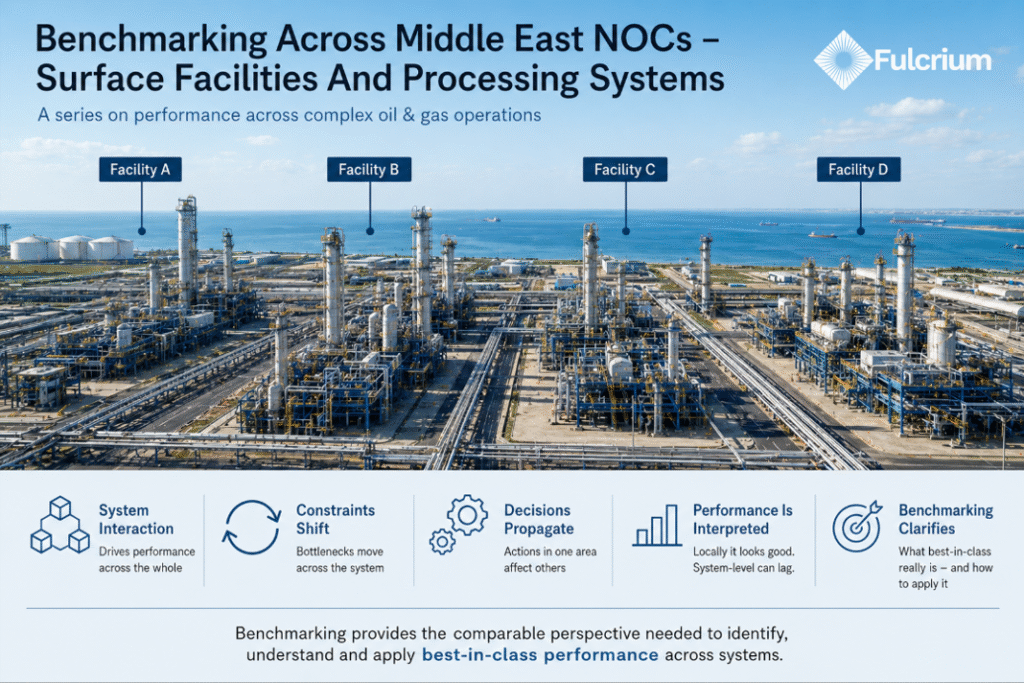
In large-scale facilities systems, performance is not defined by individual units, but by how the system behaves as a whole.
Across gas-oil separation plants, central processing facilities, compression systems, stabilisation trains, and export networks, processing is tightly coupled – often across long-life, high-throughput assets.
At this scale, capacity on paper is only a starting point.
Throughput depends on how constraints are understood and managed across the system.
This is where facilities systems become more dynamic.
A compressor operating slightly off design conditions, a separator approaching its limits, or variability in upstream fluids can introduce effects that propagate across the system.
Individually, these effects are familiar. Collectively, they shape how performance is expressed.
- Bottlenecks shift
- Trade-offs emerge
- Operational responses interact
- Decisions taken in one part of the system influence performance elsewhere – sometimes immediately, and sometimes over longer time horizons.
Across Middle East NOCs, significant capability has been built to manage this complexity.
Advanced process control, real-time monitoring, integrated workflows, and increasingly AI-enabled optimisation are improving visibility, responsiveness, and operational precision.
As a result, facilities performance continues to evolve.
- Throughput is stabilised
- Uptime is improved
- Constraints are progressively managed and, where possible, removed.
As systems become more capable and more integrated, the nature of the question begins to shift. It is no longer only about how to improve performance within a facility.
It is also about how that performance is anchored against what is fully achievable across comparable systems.
Facilities with similar configurations and nominal capacities can perform differently in practice.
Not because of a single defining factor, but because of how constraints are managed, how systems are operated, and how decisions are sequenced over time.
These differences are not always immediately visible. They are expressed through the interaction of the system.
Best-in-class performance does not immediately reveal itself. It exists – but it is not obvious.
As a result, the interpretation of facilities performance becomes increasingly important.
Not just within a single asset, but across facilities.
- Across different configurations
- Across different operating environments
- And across time.
This is where benchmarking plays a distinct role.
Not as comparison alone, but as a discipline that maintains valid, comparable interpretation of performance across facilities, fields and reservoirs, over time, and as conditions evolve – helping ensure that performance is anchored against what is fully achievable, and that insight can be applied without distortion.
Best-in-class performance is not obvious – but it exists, can be identified, and applied within and across oil & gas systems.
 '
