
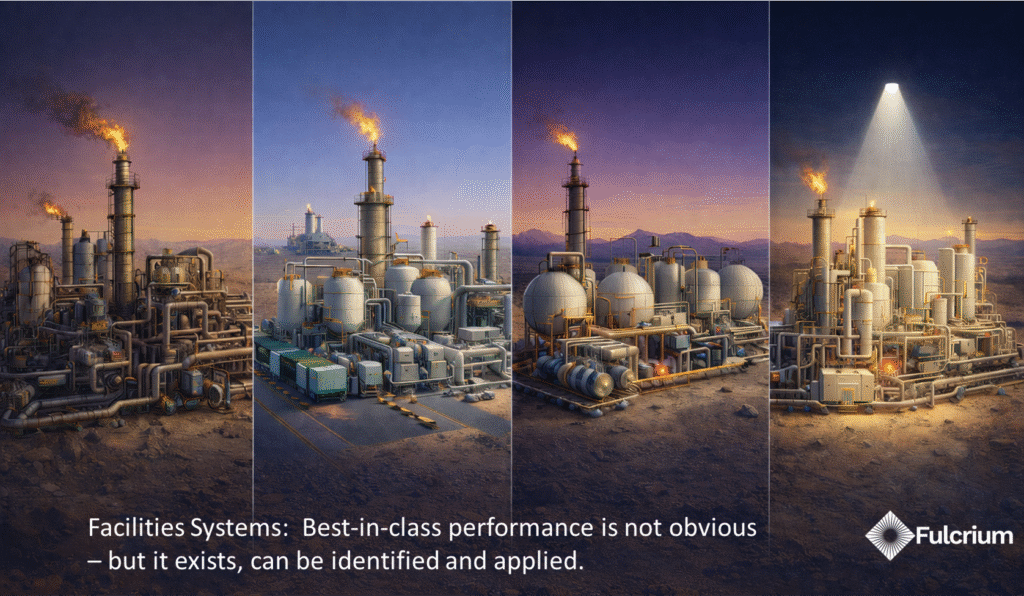
In large-scale facilities systems, performance is not defined by individual units, but by how the system behaves as a whole.
Across gas-oil separation plants, central processing facilities, compression systems, stabilisation trains, and export networks, processing is tightly coupled – often across vast, long-life assets.
At this scale, capacity on paper is only a starting point.
- Throughput depends on constraint.
- Constraint shifts over time.
- Operational responses interact.
A compressor operating slightly off design conditions, a separator approaching its limits, or variability in upstream fluids can introduce effects that propagate across the system.
Individually, these effects are well understood. Collectively, their behaviour is harder to interpret.
Bottlenecks do not remain fixed. They move.
Systems that appear stable can be operating with hidden inefficiencies – absorbed through operational workarounds, buffer capacity, or conservative settings.
Trade-offs are constant:
- Throughput versus uptime
- Efficiency versus flexibility
- Short-term optimisation versus long-term reliability
And these trade-offs rarely sit in one place. Decisions taken in one part of the system influence performance elsewhere – often subtly, and often over time.
In large, integrated production systems spanning multiple facilities and export routes, these effects become more pronounced.
Facilities with similar configurations, similar capacities, and access to similar technologies can perform very differently in practice.
Not because of one defining factor – but because of how constraints are managed, how interactions evolve, and how the system is interpreted as conditions change.
Digitalisation and automation are advancing how these systems are operated.
- Real-time data.
- Advanced process control.
- Predictive maintenance.
- Digital twins.
These capabilities are improving visibility and responsiveness.
They allow deviations to be detected earlier, systems to be monitored more closely, and decisions to be made more quickly.
And yet, performance does not converge. What appears efficient in one system may not hold in another.
The challenge is not a lack of data. It is how that data is interpreted – and whether that interpretation remains valid beyond the system in which it is observed.
Facilities performance is often assessed through utilisation, availability, throughput, and efficiency.
These metrics are necessary. But they do not, on their own, define what good looks like.
Two systems may report similar utilisation – while operating under very different constraints.
Two facilities may achieve similar throughput – while reflecting very different levels of efficiency, stability, or latent capacity.
Without a consistent basis for comparison, there is a risk that:
- performance is misread
- improvement potential is underestimated or overstated
- approaches are transferred between systems where they do not hold
Over time, these effects accumulate.
They shape decisions on upgrades, debottlenecking, operating strategy, and capital allocation.
In systems of this scale, even small differences in interpretation can translate into material differences in performance and value.
The industry has made significant progress in integrating subsurface, wells, and facilities.
But as systems become more connected, a different requirement emerges.
Not only integration within systems – but comparability across them.
How performance is interpreted across facilities, fields and reservoirs, over time, and as conditions evolve.
The challenge is not only understanding what is happening within a system. It is understanding whether that insight holds beyond it.
This is where the distinction begins to emerge – where performance takes on a different meaning. Not as comparison alone, but through the interaction of systems across the value chain.
And as a discipline that builds on these foundations. Best-in-class performance does not immediately reveal itself. It exists – but it is not obvious.
Benchmarking is the discipline of maintaining valid, comparable interpretation of performance across systems, over time, and as conditions evolve – enabling best-in-class performance to be identified and applied in a form that remains valid beyond the conditions in which it was first derived.
 '
'
