
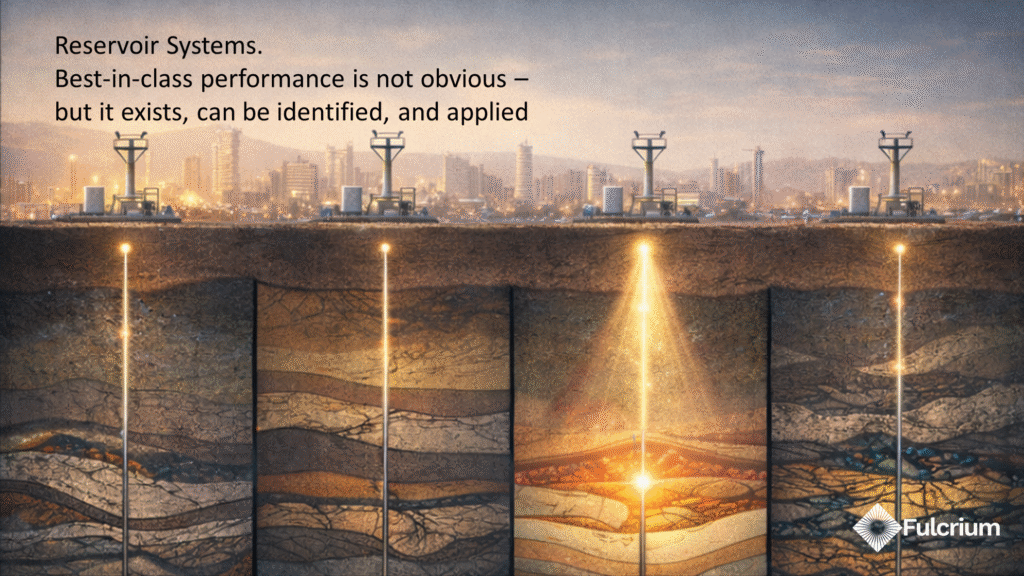
When you step into a supergiant field such as Ghawar, Burgan, or Rumaila, it becomes immediately clear that no two reservoirs are alike – even when production levels appear similar on paper.
Differences in structure, drive mechanisms, fluid systems, development history, and operating strategy all shape how performance is expressed over time.
In these environments, performance is not defined by a single metric.
It is the result of how multiple factors interact:
pressure support, sweep efficiency, well placement, completion design, and the timing and sequencing of interventions.
Across large-scale reservoir systems, this complexity is well understood.
Significant capability has been built – in modelling, surveillance, data integration, and increasingly in the application of AI – to better characterise behaviour and support more informed decisions.
As a result, performance is continuously being improved.
- Recovery is extended.
- Decline is managed.
- Production is stabilised and optimised over time.
But as capability increases, the nature of the question begins to shift.
It is no longer only about how to improve performance within a reservoir.
It is also about how that performance is anchored against what is fully achievable under comparable conditions.
Two reservoirs may exhibit similar production profiles, while operating at different levels of recovery efficiency.
Two development strategies may deliver comparable short-term outcomes, while diverging materially over the life of the field.
And two assets may both be improving – while progressing toward different performance horizons.
These differences are not always immediately visible.
Not because they are hidden – but because they are expressed through the interaction of many variables over time.
Best-in-class performance does not immediately reveal itself.
It exists – but it is not obvious.
As a result, the interpretation of performance becomes increasingly important.
Not just within a reservoir, but across reservoirs.
- Across different geological settings.
- Across different development approaches.
- And across time.
This is where benchmarking plays a distinct role.
Not as comparison alone, but as a discipline that maintains valid, comparable interpretation of performance across fields, reservoirs, over time, and as conditions evolve – helping ensure that performance is anchored against what is fully achievable, and that insight can be applied without distortion.
Best-in-class performance is not obvious – but it exists, can be identified, and applied within and across oil & gas systems.
 '
'
