
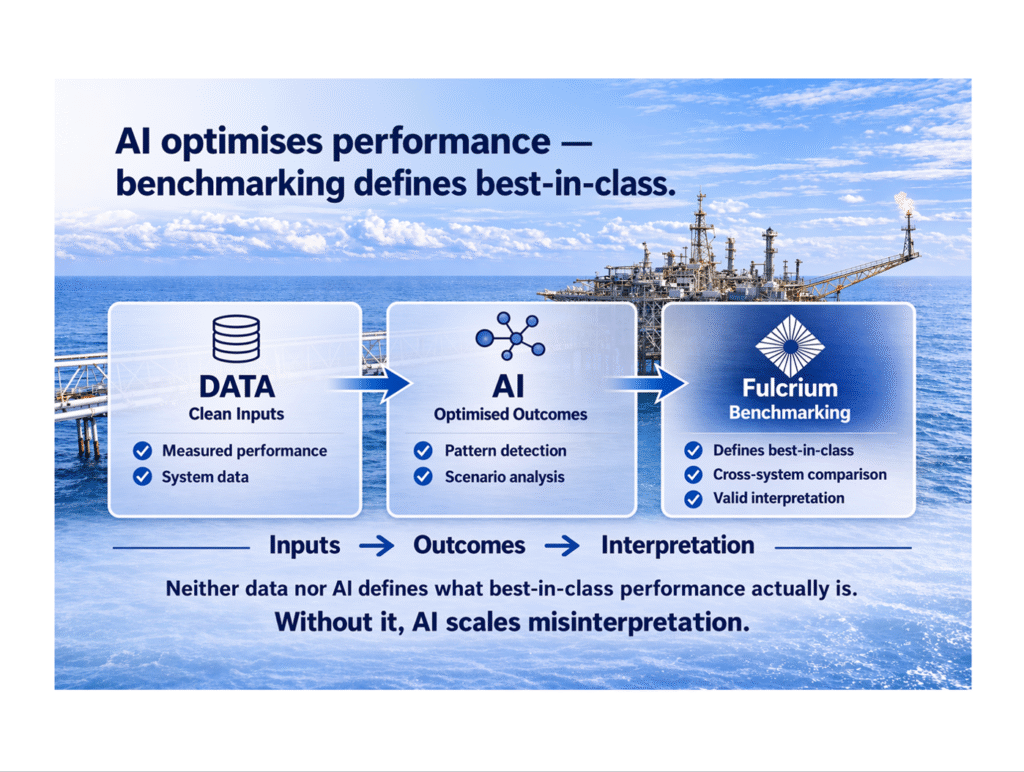
AI is rapidly becoming embedded across reservoir management, production systems, and facilities operations.
From subsurface modelling and well placement to process optimisation and predictive maintenance, AI is improving how decisions are made.
- Faster analysis
- More scenarios
- Greater responsiveness
Across Middle East NOCs, this is already translating into:
- Improved recovery strategies
- More adaptive operations
- Better use of data across systems
The direction is clear. And the progress is real.
But as AI becomes more capable, a different question begins to emerge.
Not how quickly decisions can be made –
but how those decisions are anchored.
AI learns from data:
- It identifies patterns
- It detects relationships
- It optimises within the environments it is trained on
But it does not define what “best” looks like.
It does not determine:
- How far performance can be extended
- Whether observed performance reflects constraint or potential
- Whether insights derived in one system hold in another
Two systems may be optimised using AI – and arrive at very different outcomes:
- Both may appear efficient
- Both may reflect improvement
But neither necessarily reflects best-in-class performance.
This is where a deeper distinction emerges.
Between:
- Improving performance, and actually
- Understanding what performance should be
Across reservoirs, facilities, and integrated systems, performance is shaped by context:
- Geology
- Design
- Operating strategy
- Constraint
AI can optimise within that context.
But it does not establish whether that context itself reflects what is achievable.
This creates a subtle but important gap.
One that is not immediately visible – particularly as systems become more data-rich and more responsive.
Without a consistent basis for comparison:
- Optimisation can reinforce local constraints
- Improvement can be measured against incomplete benchmarks
- Targets can remain implicit, rather than defined
Over time, this limits how far performance is extended.
Not because capability is lacking –
but because the reference point is not clear.
The challenge, then, is not only to improve performance.
It is to define it.
This is where benchmarking operates.
Not as an alternative to AI – but as a foundational layer.
Providing an independent, consistent, validated basis for understanding performance across systems, over time, and as conditions evolve.
Best-in-class performance does not immediately reveal itself.
It exists – but it is not obvious.
Benchmarking is the discipline of maintaining valid, comparable interpretation of performance across systems, over time, and as conditions evolve – making it possible to extend performance materially beyond what would otherwise be achievable.
 '
'
